Part I · Store Consciousness
Verse 10 · The Five Universals
The ground of the mind, where all our seeds are kept — and how they ripen into the worlds we live in.
Unobstructed and indeterminate,store consciousness is continuously flowing and changing.At the same time, it is endowedwith all five universal mental formations.
This page is our current understanding, written as we work through the book together — it changes as our understanding changes.
10.01Three Qualities of Store
The first reading on Verse 10: what its three words for store consciousness — unobstructed, indeterminate and continuous — each mean, and why the chapter ends by saying that these are what make transformation possible.
The Reading
Verse 10 reads:
Unobstructed and indeterminate, store consciousness is continuously flowing and changing. At the same time, it is endowed with all five universal mental formations.
The first nine verses said what store consciousness does: it holds the seeds of everything we have lived through, it keeps every kind, it loses nothing, and its seeds ripen. Verse 10 says what the store is like. Thich Nhat Hanh, whom his students call Thầy, opens his commentary on it with one sentence: “This verse describes qualities of the store consciousness that differentiate it from the other consciousnesses.”
The verse has two halves. The first gives the store three qualities: it is unobstructed, it is indeterminate, and it is continuously flowing and changing. The second says it works with the five universal mental formations, and we come to those in the next reading. This reading takes the three qualities one at a time, and each one is clearest beside the consciousness it is being set against, which is usually manas. Then it reads the last paragraph of the chapter, where Thầy says why the three matter.

The Teaching
Unobstructed
Thầy’s first gloss in the book is short. “‘Unobstructed’ means exposed to the light, not hidden. Store consciousness is unobstructed because it has the capacity of attaining absolute clarity.” He says more when he comes back to it in the chapters on manas: “The nature of store consciousness is unobstructed, which means it can become true mind, Buddha nature. There is no obstacle standing in its way. There is the possibility of reaching the realm of things-in-themselves.”
The realm of things-in-themselves is the first of the three fields of perception from Verse 8: things met directly, before the mind has made a picture of them. The store can reach it because of the way it perceives. “The store consciousness does not engage in thinking, comparing, or imagining. Its mode of perception is always direct.” It does not stop to name a thing, compare it with something else, or decide what it means; it takes the thing as it is.
At the Winter Retreat on the Thirty Verses, in 2013 and 2014, Thầy used the Vietnamese term vô phú, which means “not covered”, and he gave the store’s direct perception as the reason for the name (12 January 2014). In another talk of that retreat he said what does not cover it: ideas and notions, such as the notion of a beginning and an end, of being and non-being, of good and evil (5 January 2014).
The word is clearest beside manas, which Verse 19 calls “indeterminate and obscured.” Thầy explains: “‘Obscured’ means to be ‘covered up.’ You cannot see the light if there is something covering it up.” The covering has a name: “The veil of ignorance that covers manas is the tendency to discriminate between self and nonself.” So manas “does not have the capacity to touch the realm of things-in-themselves. It can never touch the realm of suchness of store consciousness. Its object is an image of a self that exists only in the realm of representation.” At a retreat in 1997, teaching in English, he put it this way: “‘Obstructed’ means it is caught… There are obstacles on the way. That is why manas cannot touch the realm of suchness, the realm of things in themselves.”
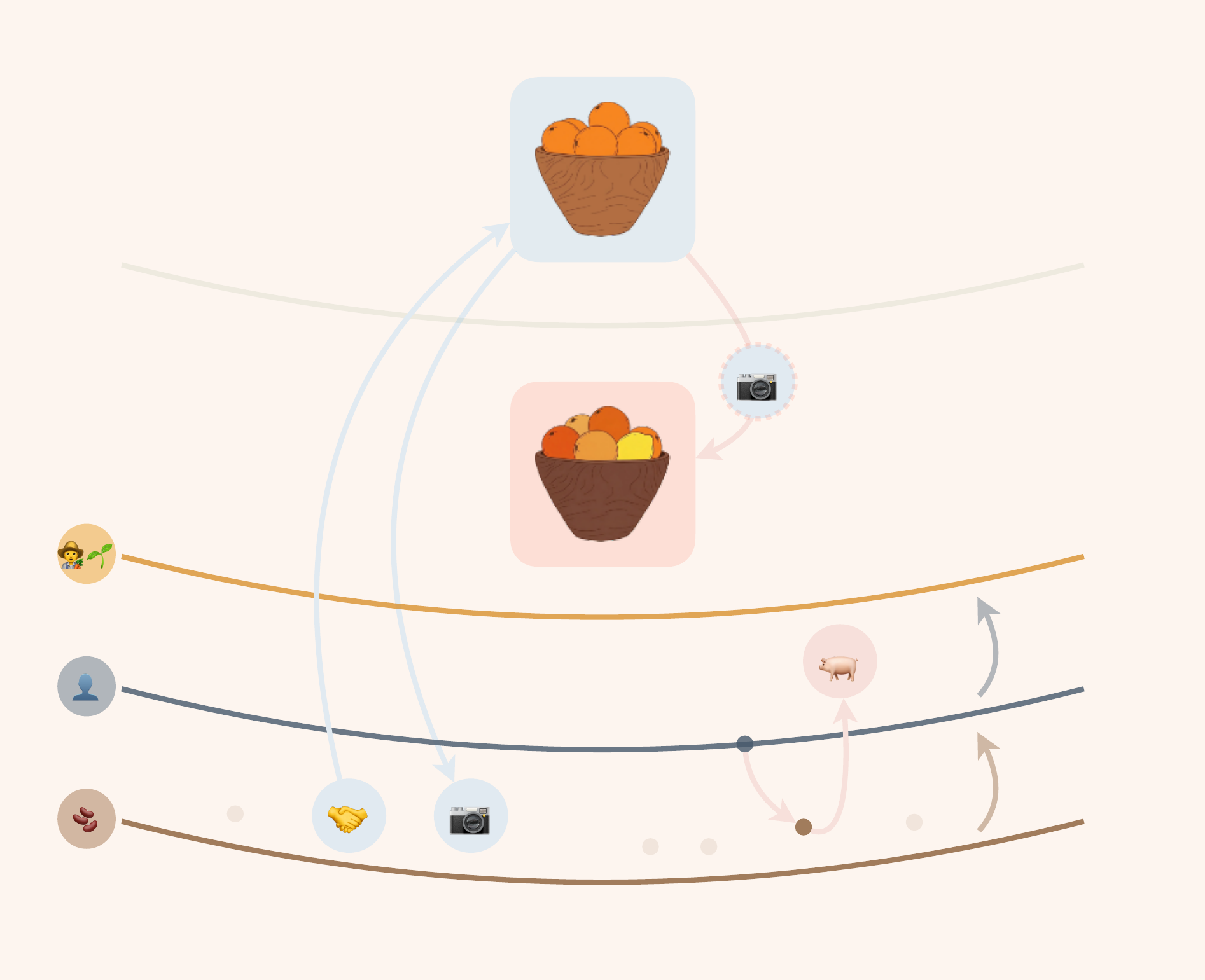
If the store is unobstructed, why don’t we see clearly? Thầy answers in the chapter on Verse 15: “There is so much ignorance and delusion in our usual way of perceiving and experiencing things that our store consciousness cannot reveal itself to us as a part of the ultimate dimension. But in fact the essential nature of store consciousness has always been free of afflictions.” The covering is in the consciousnesses we usually see with, manas and the mind consciousness that rests on it, and not in the store. When the seeds of delusion are transformed, Verse 15 says, the store becomes the Great Mirror Wisdom, “reflecting the cosmos in all directions.” The readings take that up when they reach Verse 15.
The book and the 1997 talk describe being unobstructed as a capacity: clarity can be reached. The Winter Retreat and Thầy’s 1963 thesis describe it as something already true: the store is not covered. These are two ways of saying it, and in his last talks on the subject Thầy went further than the book.
Indeterminate
The book names the second quality in its next sentence: “It is also indeterminate, meaning that store consciousness itself is neither wholesome nor unwholesome, though it contains all the seeds, both wholesome and unwholesome.” Then Thầy lays out the three natures that every action, word and thought belongs to: “Wholesome means useful to ourselves and others. Unwholesome means harmful to ourselves and others. Indeterminate means that an action, word, or thought is neither inherently wholesome nor unwholesome. It can be either, depending on the circumstances.”
So the store holds seeds of all three natures and has none of the three itself. His image for this is the earth. “Like the earth, store consciousness has the task of holding seeds. We know that store consciousness is itself neutral by nature.” At the Winter Retreat he named both kinds of seed: “Mother Earth has all the seeds, the seeds of Mara, the seeds of Buddha… and it’s up to us to decide what to choose” (8 December 2013). A week later he drew the consequence: because the store is indeterminate, “you have a choice to choose. You can choose one of the six paths, or you can choose nirvana” (15 December 2013).
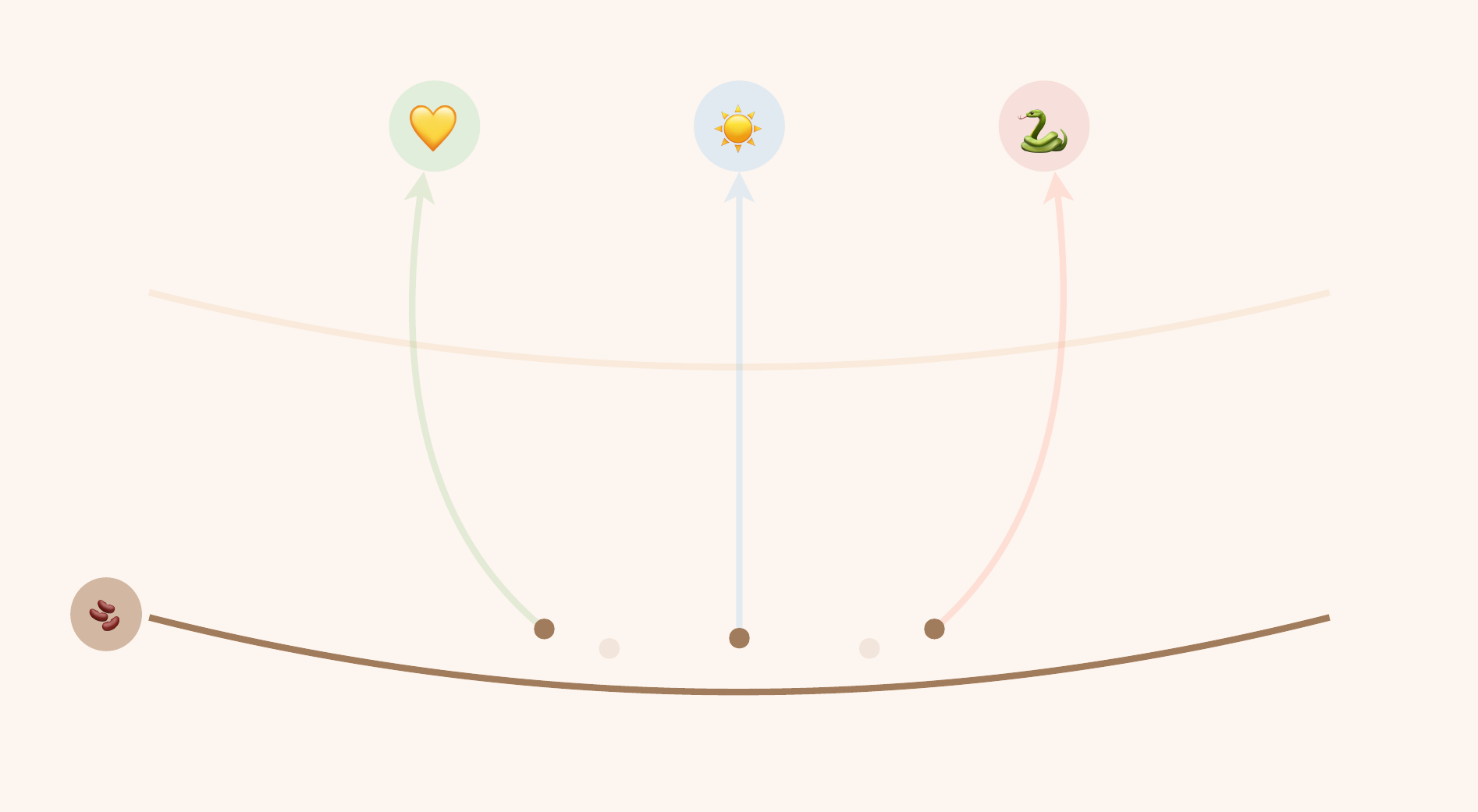
The formations in that figure are joy, insight and aversion, and the colours are the ones the Inner Landscape uses for the three natures.
Why does the store have to be neutral? Thầy’s answer at the Winter Retreat is that only something neutral can take on what is put into it (12 December 2013). His first image was tea: “Just like tea. It’s neutral.” That is why it can be scented with lotus flowers or jasmine. His second was cloth: a piece of white fabric can be dyed red or black or blue, but a cloth that is already red is hard to dye another colour. The jasmine tea is the same image the book uses for Verse 7, where Thầy explains habit energy: jasmine flowers shut in a box with the tea for several weeks, until the tea smells of them. Experience scents the store the same way, and it can only do so because the store has no scent of its own. In his thesis of 1963 Thầy put it in the older vocabulary: “the nature… of Alaya is neither good nor evil. It is neutral (avyākṛta 無記). So it admits the impregnation (vāsana) of both the good and the evil.”
Manas is indeterminate too. “The nature of manas is indeterminate, like store consciousness.” Thầy says this is why manas can change: “The transformation of manas can happen because it is indeterminate. The earth can give rise to thorns and brambles, but it can also give rise to fragrant fruits and flowers.” So being indeterminate is not what sets the store apart from manas; being unobstructed is. Manas is indeterminate and obscured, and the store is indeterminate and unobstructed, which is why the verse needs both words. (The book also uses indeterminate for something else entirely, and the word has two jobs. And a reader may fairly ask, if the store is neutral, whether our nature is good.)
Continuous, flowing and changing
“Store consciousness operates continuously, day and night, without stopping.” The other consciousnesses are not like that. A sense consciousness arises only when its sense organ is in contact with something: eye consciousness “operates during the day but not when we are asleep, because our eyes are closed and do not perceive any object.” Then the book says: “If we are asleep and not dreaming, mind consciousness stops also.” Verse 26 lists the other times mind consciousness stops: in states of non-perception, in two deep meditative attainments, in deep sleep, and in fainting or coma. Manas does not stop: “Like store consciousness, manas never ceases in its activity.”
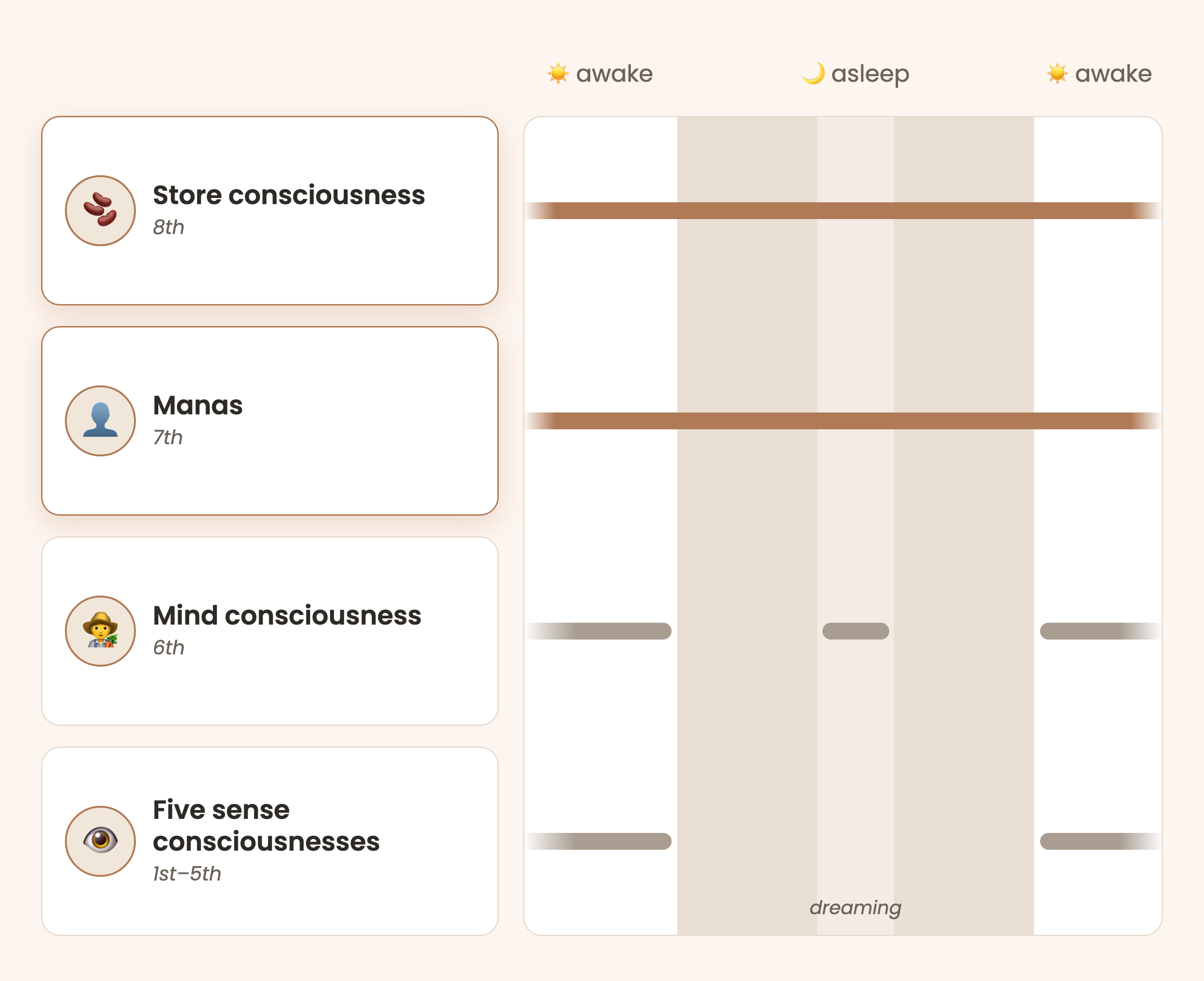
At the Winter Retreat Thầy said why this matters for the store in particular. The senses and mind consciousness can stop and we are still alive, “but store consciousness, if it stops, then we die” (28 November 2013). While we sleep, he said in another talk, the store goes on looking after the body: digestion, the heartbeat (16 January 2014).
Continuous does not mean unchanging, though, and the book says so at once: “Even though store consciousness never ceases, this doesn’t mean that it is always the same. It is continuously flowing and changing, like a river. A river is always the same river, but the water in it is always changing. Store consciousness is the same. It is the river, and the seeds it contains are like the water that is changing all the time.” In 1997, glossing this verse aloud, Thầy said: “It does not mean permanent. It is always changing.” The river is older than Thầy’s book. Vasubandhu’s Thirty Verses, which the Fifty Verses build on, say of the store: “It functions like the current of a river.” And in his thesis Thầy wrote: “Ālaya is not identical with itself in two consecutive moments.”
This matters because of what manas does with the store. Manas “embraces and clings to this aspect of store consciousness, makes it into an object, and that object becomes an idea of self.” It “continues to believe in the idea of a permanent, eternal self.” The store is the one thing in the mind that never stops, so it is the obvious place to look for a self that lasts. But what manas holds on to is a river. The next verse says this in its first line: “Although impermanent and without a separate self, store consciousness contains all phenomena in the cosmos…” So the store really is continuous, but the permanent self that manas builds on that continuity does not exist.
There is one more difference in the book, and it pairs with this one. “Unlike store consciousness, which is continuous but does not discriminate, the nature of manas is both continuous and discriminating.” Going Deeper sets all eight consciousnesses side by side on these points.
Why the three qualities matter
The chapter’s last paragraph ties the three together.
“The qualities of the store consciousness that make it unique are also the same qualities that allow for transformation of the seeds it contains. Because store consciousness is unobstructed and indeterminate, because its nature is neutral, and because it is always flowing and changing, it can be transformed. Every day is an opportunity for transformation. When we transform the seeds in our store consciousness, that is transformation at the base.”
If we read it with the rest of the chapter, each quality supplies one condition. Because the store is indeterminate, it can take on what we water, as the tea takes on the jasmine. Because it is always flowing and changing, nothing in it is fixed for good, so a seed watered today can change what the store is tomorrow. Because it is unobstructed, the clarity the practice is looking for is not somewhere else, but in the store, under the covering that manas and our usual perception add. That last step is our reading of how the three fit together; the book gives the three and the conclusion.
Thầy’s image for who does what is the gardener and the earth. “The other seven consciousnesses are the gardeners that till the earth.” We turn the soil, sow, water and weed. “But we cannot do the work of the earth.” And then: “What is most important is to have faith that the earth will germinate the seeds that have been sown.” The three qualities are why that faith is reasonable. The earth holds any seed, it never stops working, and nothing in it is fixed.
You can notice the difference between the store’s way of perceiving and ours in a small way. Listen to a sound, such as a bird, traffic or a fridge, without naming it or deciding whether it is pleasant. For a moment there is just the sound. Then the name arrives, and with it a judgement, and the moment of plain hearing is over. The book’s word for the first moment is direct.
Contemplation Questions
The store does its work silently, like the earth, even while we sleep. Have you ever woken up knowing something you did not know the night before? When you have an important decision, do you ever sleep on it, and why?
Manas holds on to the idea of a self that never changes. What is something about yourself that you thought would never change, but has?
Can you remember a moment when you saw something just as it was, before you started thinking about it?
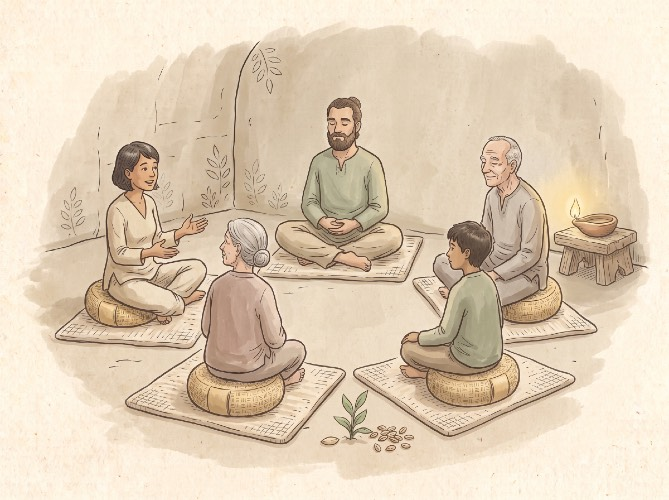
Carry whichever of these stays with you — into your own quiet reflection, or into conversation with others.
Going Deeper
A few notes for anyone who wants to follow a thread further.
How the eight consciousnesses compare
The book makes these points in different chapters, and they are easier to hold side by side. Every cell below comes from the book.
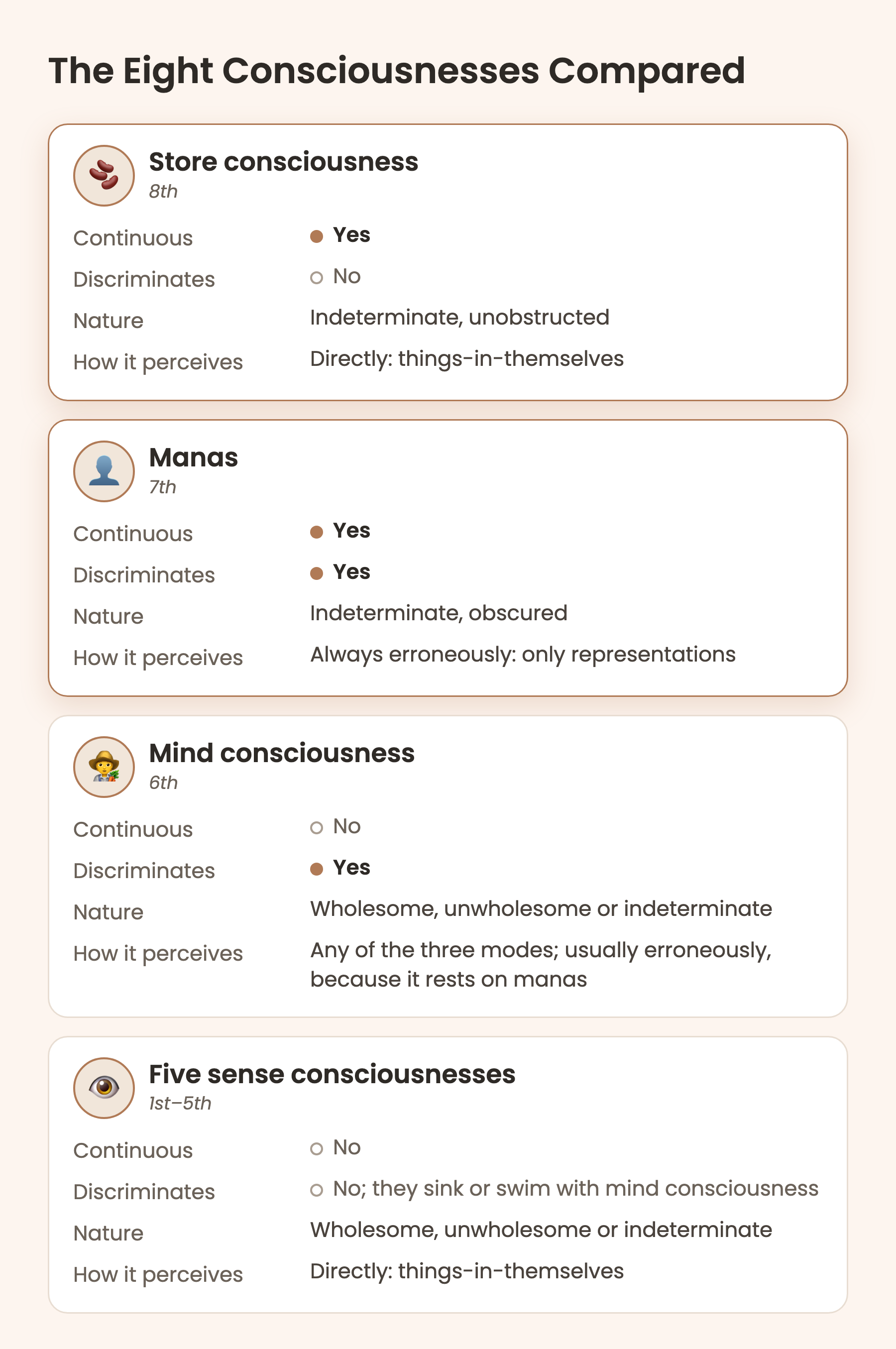
Continuous. The Verse 10 chapter gives store consciousness and manas (p. 47); the Verse 19 chapter repeats that manas, “like the store consciousness, is continuous”; the chapters on mind consciousness say that it and the five sense consciousnesses are not, and Verse 26 lists when mind consciousness stops.
Discriminates. “Unlike store consciousness, which is continuous but does not discriminate, the nature of manas is both continuous and discriminating.” For mind consciousness and the senses, the Verse 29 chapter says that the senses perceive directly until mind consciousness joins in: “Mind consciousness tends to discriminate between things, name them, or compare them, and when it does, the realm of things-in-themselves is no longer available.” The senses themselves do not discriminate, but when they work with mind consciousness, Verse 30 says, “they sink or swim with the mind consciousness.”
Nature. Verses 10, 19, 24 and 29. Verse 29 says the senses can be “wholesome, unwholesome, or neutral”, and Verse 24 gives mind consciousness the three natures; the table uses one word, since the book treats neutral and indeterminate as the same.
How it perceives. The Verse 29 chapter says the five senses are “like the eighth consciousness, store consciousness, which also has the direct mode of perception and whose field of perception is also the realm of things-in-themselves,” that “the mode of perception of manas is always false,” and that mind consciousness, “because it is based on and influenced by manas,” is usually erroneous as well.
At the Winter Retreat (28 November 2013) Thầy taught the first two columns as a pair, in Vietnamese hằng and thẩm: the store is continuous but does not deliberate; manas does both; mind consciousness deliberates but is not continuous; the five senses do neither. The interpreter’s English for thẩm was “cogitating”, where the book says “discriminating”.
Is the store clear already, or can it become clear?
The book describes the store’s clarity as a capacity: “it has the capacity of attaining absolute clarity,” and it “can become true mind, Buddha nature.” In 1997 Thầy said the same: “Unobstructed because [ālaya] has the capacity of being transformed.” The book also says the store perceives directly now, and that its “essential nature… has always been free of afflictions.” At the Winter Retreat the emphasis moved to the present. The store is vô phú, not covered. His thesis of 1963 had said so too: “The term covered (有覆) means to be veiled and conditioned by ignorance. The Ālayavijñāna is however non-covered (無覆)…”
In December 2013 he still taught it the book’s way. Of the store he said, “we cannot let it go, we can only transform it,” and that when we are not enlightened it is indeterminate, “but when we are enlightened, it becomes wholesome” (15 December 2013). In January 2014 he went further. In one talk, which we have in one transcription only, he says the store does not need to be transformed and calls this “something new” (12 January 2014). Two weeks later he said it plainly, and both transcriptions agree: “manas and mind consciousness are consciousnesses that need to be transformed. Whereas store consciousness is already perfect, it does not need to be transformed. This is our ground” (26 January 2014).
The book says the opposite in so many words: “Transformation occurs in the store consciousness,” and the chapter on this verse ends on “transformation at the base.” We follow the book, because it is the text these readings teach. The January view is Thầy’s own and later, and we give it here so that a reader who meets it in the retreat talks knows that it differs from the book and that the difference is his. Neither 1997 nor the thesis says already perfect.
If the store is neutral, is our nature good?
Thầy asked the question himself. The talk he gave on 12 December 2013 at the Winter Retreat is titled Is Our Nature Goodness, and his answer was that it is neither good nor bad: “So in Buddhism we say that the human nature is indeterminate.” In his thesis he named the view this school sets aside: “The theory of Mencius… that the human nature is good… is therefore not in accordance with the Vijñānavāda doctrine.” Mencius’s own explanation, he wrote, is that evil comes from contact with evil neighbours, which cannot explain how evil began if everyone was good to start with.
The book complicates this. It says the store’s essential nature “has always been free of afflictions,” and that the store “can become true mind, Buddha nature.” That sounds closer to good than neutral does.
Our reading is that the two answers are to different questions. Neutral is about the seeds. The store holds wholesome and unwholesome seeds without being either, as the earth holds thorns and flowers. Free of afflictions is about whether the afflictions belong to the store itself or only to what it holds, and Thầy says the store’s essential nature has always been free of them. In the same December talk he raised the hardest form of the problem himself: if some seeds were good or bad from the beginning, “then alaya cannot be called indeterminate.” His answer was that a seed’s nature is organic. A flower becomes compost and compost becomes a flower, so no seed is fixed as good or bad, and a neutral store can hold them all.
The word indeterminate has two jobs in this book
In the Verse 10 chapter, indeterminate (the book gives aniyata) is the third of the three natures: neither wholesome nor unwholesome, and the store’s own nature. The book uses the same word, aniyata, for four of the fifty-one mental formations: regret, sleepiness, initial thought and sustained thought. Those four are indeterminate in a narrower sense: each one can go either way depending on how it is used. Regret is wholesome when it moves us to make amends, and unwholesome when it sinks into brooding. Sleepiness is wholesome as needed rest, and unwholesome when it clouds the mind during practice.
The two uses are easy to run together, and the store is not a fifth member of that group. In the thesis and at the Winter Retreat Thầy uses a different word for the store’s nature, avyākṛta (vô ký in Vietnamese). The four formations keep aniyata.
Do the senses really stop when we sleep?
A careful reader will object that a loud noise wakes us, so something was listening. The book’s own wording allows for this. Its example is the eye, which stops “because our eyes are closed and do not perceive any object,” and its rule is that “only through contact with its object does a sense base give rise to a sense consciousness.” When a sound reaches us in the night, ear consciousness arises for as long as the contact lasts. The chart of which consciousnesses never stop draws the senses as off for the whole night because its subject is continuity, and the senses are not continuous.
Thầy on this verse, in his own words
On 6 November 1997, at a retreat on Buddhist psychology in Key West, Florida, Thầy read Verse 10 aloud and glossed it in English, in under three minutes: the recording on Vimeo, from 1:37:46 to about 1:40:30, and the transcript. He gives each quality a line. “Indeterminate means that it is neither wholesome or unwholesome… it depends on our way of life.” He contrasts the store with eye consciousness and ear consciousness, which stop when we sleep, and then says: “It does not mean permanent. It is always changing.” The recording is from 1997 and quiet in places, but it is the teacher of this book explaining this verse.
10.02Five in Every Moment
The second reading on Verse 10: what a mental formation is, the five formations the verse calls universal, and the practice Thầy built on one of them, attention.
The Reading
Verse 10 reads:
Unobstructed and indeterminate, store consciousness is continuously flowing and changing. At the same time, it is endowed with all five universal mental formations.
The first reading on this verse took its first half, the three qualities of store consciousness. This reading begins the second half. Before Thầy can say what the store works with, he has to introduce a term that the rest of the book depends on, and he does it in one paragraph:
“The term ‘mental formations’ is a very important term in Buddhism, and it is one we will encounter throughout this book. A mental formation is the result of the manifestation of a seed in our store consciousness. The Manifestation Only school divides mental formations into fifty-one categories, which we will discuss in detail later in the Fifty Verses. To understand this verse, we need to know that there are five universal mental formations: contact (sparsha), attention (manaskara), feeling (vedana), perception, or conceptualization (samjña), and volition (chetana). … They are called universal because they are active in all eight consciousnesses.”
The paragraph does two things. It says what a mental formation is, and it names the five universal ones. This reading takes those two, follows the five through a single moment, and then turns to attention, because Thầy built a practice on it. The sentence left out of the quotation says the five are “associated,” and the rest of the chapter is about how the five work inside the store itself. A later reading on this verse takes both up.
The Teaching
What a mental formation is
The book’s definition is one sentence: “A mental formation is the result of the manifestation of a seed in our store consciousness.” The chapter on Verse 12 defines the two words it rests on: “‘Seed’ means something that has the capacity of manifesting. ‘Formation’ means what has been manifested.” A seed is something that can come up, and a formation is what has come up.
Thầy’s example there is anger. “When we don’t feel angry, the seed of anger has not manifested, though it is still present in our store consciousness. When someone says something unpleasant or hurtful to us, he waters the seed of anger in us. The seed manifests itself in our mind consciousness and becomes a mental formation.” Wholesome seeds work the same way. A seed of joy can lie in the store for a long time. Then an old friend arrives at the door, the seed is watered, and joy comes up. That joy is a mental formation.
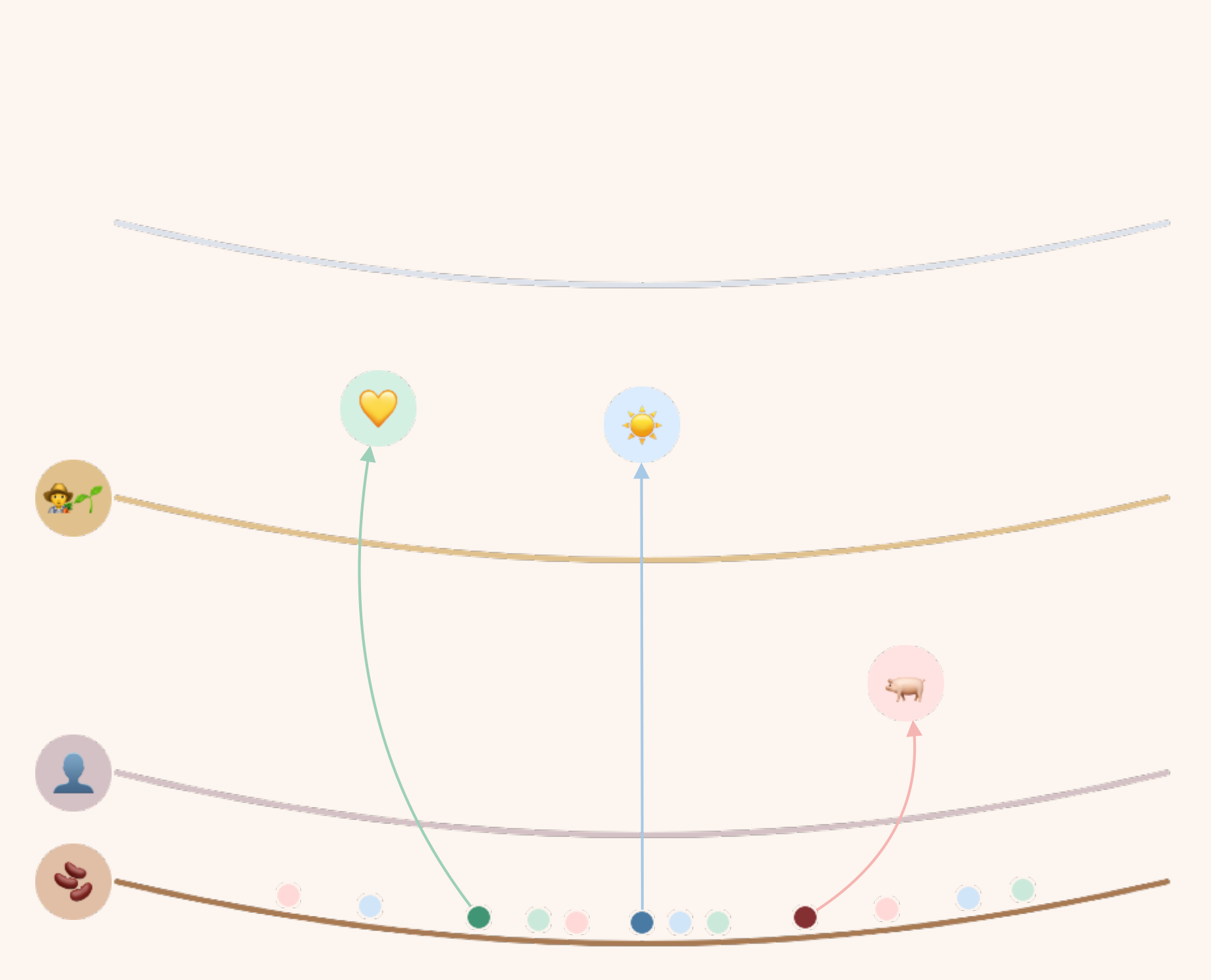
Mental formations come up in mind consciousness, and the chapter on Verse 24 says that every one of them can: “All the mental formations can manifest in mind consciousness.” Some come up with manas as well, and the chapter on Verse 20 begins: “Many of the fifty-one mental formations operate together with manas.” The figure above shows delusion coming up with manas.
At the Winter Retreat in 2013 Thầy gave an image for the difference between a seed and a formation: “the seed, when it is H2O, we call it a seed. But when it becomes rain, snow, ice, then it is called formation” (5 December 2013). The point he drew from it that day was that the seed and the formation are not two separate things. The rain is still H2O. The book makes the same point in the chapter on Verse 12: “A seed doesn’t necessarily disappear when the formation is manifested. Seeds and formations inter-are.” Rain and snow are not states of mind, so the image is about formations of every kind, and mental formations are one kind of them.
The same chapter adds what happens after a formation has come up, and the rest of this reading leans on it. “After manifesting for some time in the upper level of our consciousness, our anger will return to the root and the seed will become a little bit stronger. If we allow any seed to have occasion to manifest as a formation, that seed grows bigger and stronger.” Each time a seed comes up as a formation, the seed in the store ends up a little stronger.
The fifty-one, and the five that come first
The Manifestation Only school counts fifty-one kinds of mental formation. The book gives the count in the chapter on Verse 24: “There are fifty-one categories of mental formations: five universal, five particular, eleven wholesome, twenty-six unwholesome, and four indeterminate.” The chapter on Verse 30 lists them all, and the Inner Landscape has an entry for each one. The five universals come first.
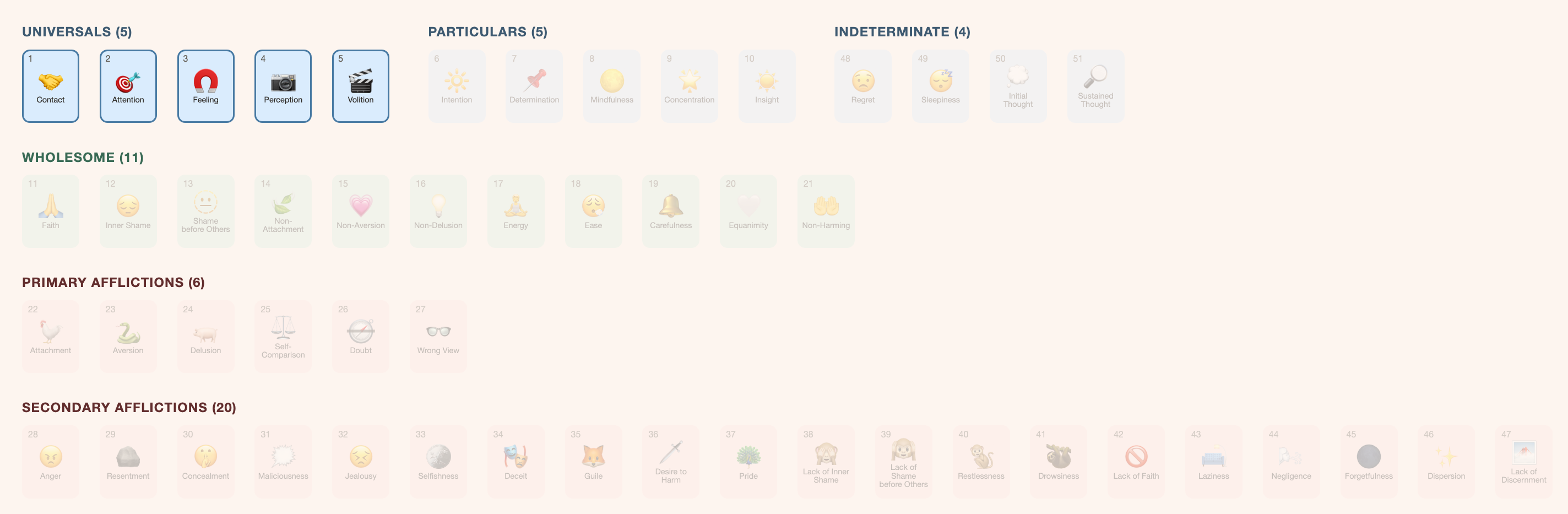
The book names the five here but does not say what each one is. Below, each has a short gloss of ours, with Thầy’s own words from a retreat in 1997, where he taught in English and took the five in the same order as the book:
- 🤝 Contact: a sense organ, an object and consciousness meet. His gloss in 1997 was “the contact between object and subject of cognition.” At the Winter Retreat he gave the traditional definition: a vibration, a change in the sense organ, when organ, object and consciousness come together (28 November 2013).
- 🎯 Attention: the mind turns toward the object. In 1997, “paying attention to the object of cognition.”
- 🧲 Feeling: what we meet feels pleasant, unpleasant or neutral. In 1997, “the feeling as a result of this kind of contact and attention.”
- 📷 Perception: the mind recognises what the thing is and names it. “After that, there’s a perception of what is there.”
- 🎬 Volition: the mind decides, and moves us to act. In 1997 he called it “the decision” that “happens after perception.”
Contact is the one the chapter has already used. In its first half Thầy explains why eye consciousness stops when we sleep: “Only through contact with its object does a sense base give rise to a sense consciousness.”
One moment, with all five
The five are easiest to see slowed down. Take one sound of the bell, which in Plum Village is an invitation to stop and come back to the breath. The sound reaches the ear and hearing begins, and that is contact. The mind turns toward the sound, which is attention. The sound feels pleasant, or unpleasant if it startles us, and that is feeling. Recognising it as the bell is perception. Then we decide what to do, which is volition, and in Plum Village what we do is stop and breathe.
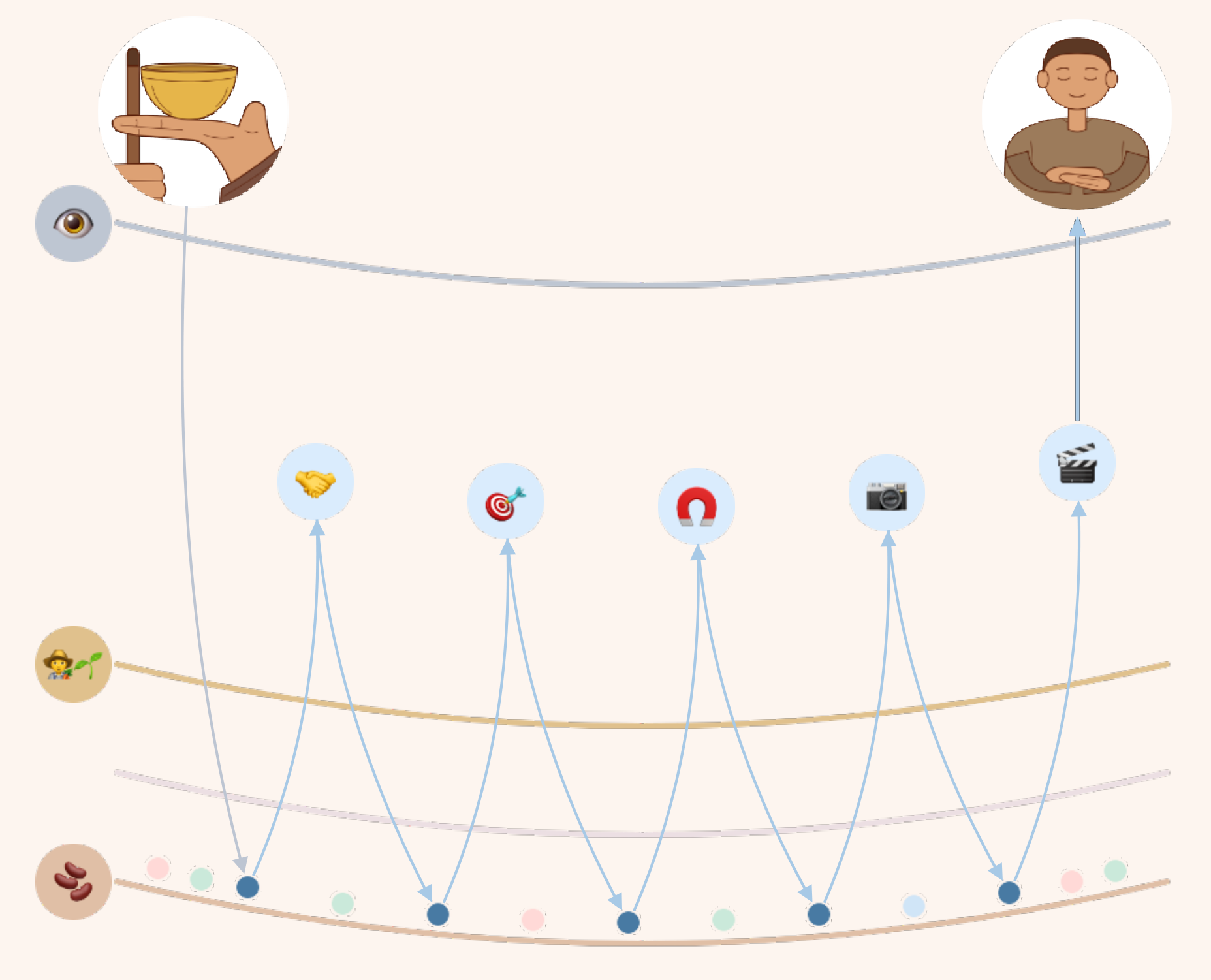
The diagram slows the moment down so that each of the five can be seen. In life they are much faster. At the Winter Retreat Thầy said they happen “in a split of a second” (28 November 2013), and that they do not always come in this order: sometimes feeling comes first.
The same five are part of every moment of the day, whether anyone notices them or not. A phone buzzing on the table, the smell from a bakery, a car horn at a crossing and a name called across a room each have all five. The feeling can be pleasant, unpleasant or neutral, and it can change: the name called is neutral at first, and what we feel next depends on whose voice it is.
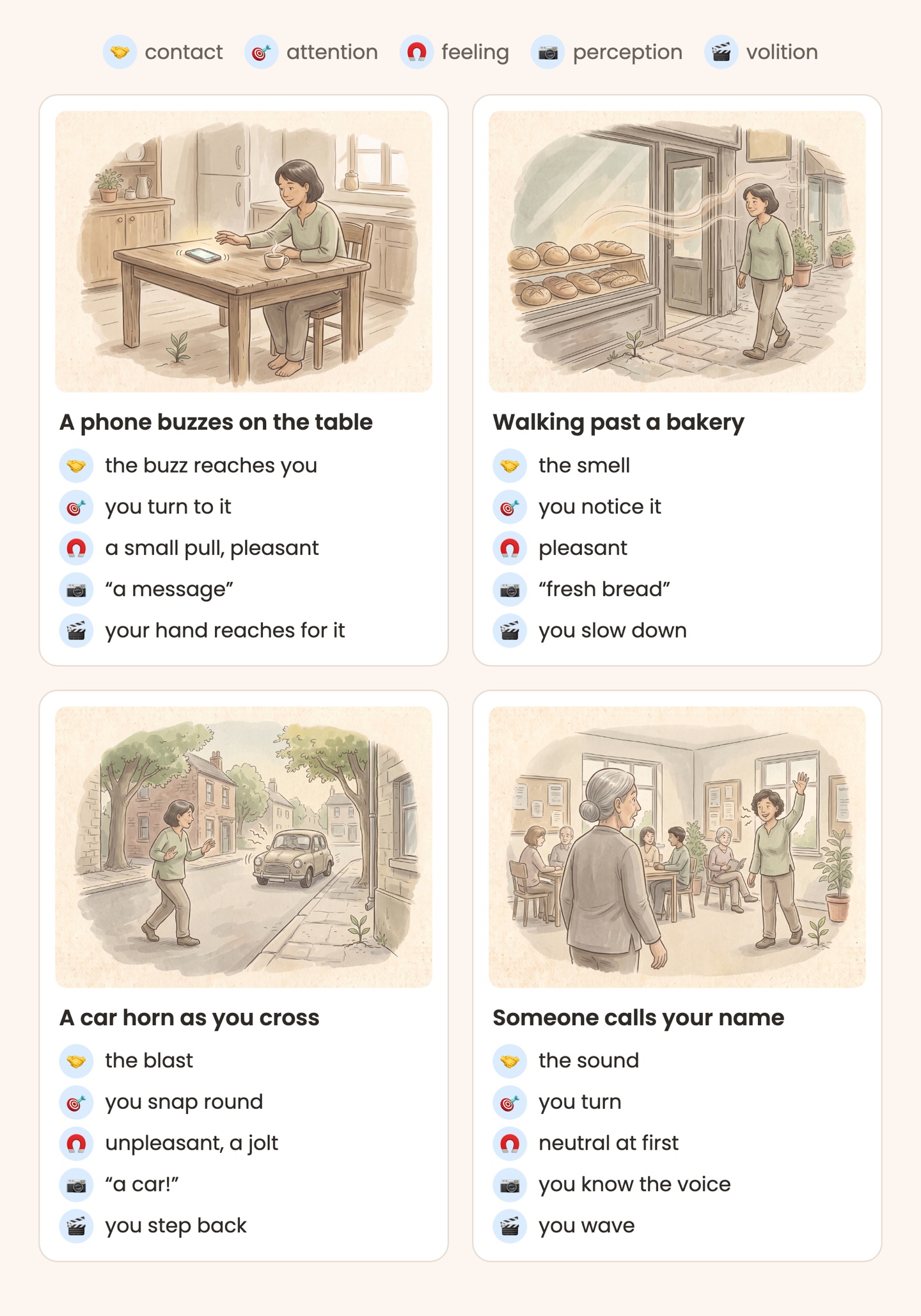
Appropriate attention
This reading follows attention further than the other four, because Thầy built a practice on it. Our senses are in contact with many things at once. At the Winter Retreat (28 November 2013) he said that “attention only chooses one of the contacts to pay attention to,” and that there are two kinds of it: “When attention leads to something that is unwholesome, it’s called inappropriate attention. And when it directs to something that is positive, then it’s called appropriate attention.”
His example came from the meditation hall. The bell is invited while people in the room are whispering. If we follow the whispering, he said, “then our mind is dispersed. And if we pay attention to that, we can be irritated.” That is inappropriate attention. If we turn to the bell instead, “the bell becomes the object of our mind, and we have the opportunity to calm our mind,” and that is appropriate attention. He put the rule in one sentence: “As a practitioner, we have to direct our mind towards objects that are beneficial for us.”
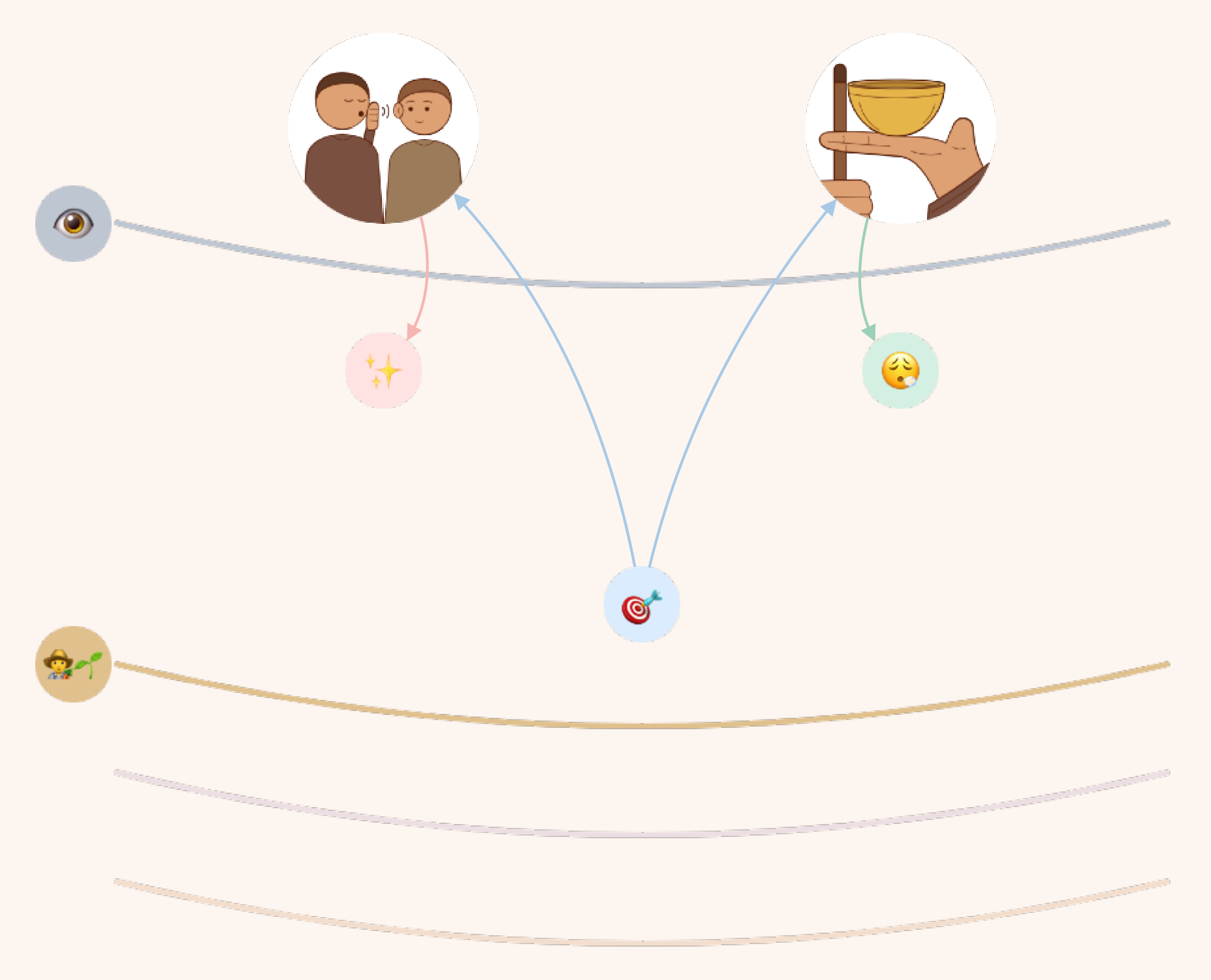
The formations at the end of each arrow are dispersion and ease.
Thầy took the same rule out of the hall. A place for practice should be arranged so that “the sounds, the images, all help us to touch appropriate attention.” The internet is full of objects for the mind, and “if there is appropriate attention, then we don’t go to websites that are unhealthy, unwholesome, that are toxic,” but to ones that teach, “such as a place where we can search for the sutras.” Because attention moves in a split second, he said, we have to train it.
In The Heart of the Buddha’s Teaching he says what this means for a day. Attention is universal, “which means we are always giving our attention to something.” It never switches off, so the practice cannot be a single decision either: “The practice is to find ways to sustain appropriate attention throughout the day.” (Why he says appropriate.)
Attention also decides which seeds get watered. Whatever attention turns to can water a seed, and each time a seed comes up as a formation, it ends up a little stronger in the store. The book’s name for choosing which seeds to water is selective watering: “We should strive to learn to identify all the positive and negative seeds in us. Then we can refrain from watering the negative seeds, and use every opportunity to water the positive seeds.” The book does not tie selective watering to attention in so many words. Putting the two together is our reading, but each half is Thầy’s.
He describes the same mechanism with fear in a short film made from a talk of 1998, The Seed of Fear in Us. Fear “is in us, in the form of a seed. And every time that seed is watered, maybe a sound, maybe a sight, anything can touch that kind of seed in us.” The opposite seed is in us too, the seed of non-fear, “but no one has helped us to identify that seed and to practice watering that seed.”
You can watch all of this with one sound. When a bell rings, or a phone, let the sound be your object and listen until it has completely gone. Notice how it felt, pleasant, unpleasant or neutral, and that you knew what it was without deciding to know. Thoughts are objects too, and attention goes to them the same way. When it does, you can choose the breath again. Each time we come back to the breath, we water the seed of mindfulness in the store.
Contemplation Questions
The book says that when someone says something unpleasant or hurtful to us, they water the seed of anger in us. Good seeds are watered the same way. What has watered a good seed in you recently?
When a sound calls you, whether a bell, a phone or your name, can you notice any of the five: contact, attention, feeling, perception or volition? Which one is easiest to see?
Where does your attention go when you pick up your phone? Does it take you somewhere that helps you?
Carry whichever of these stays with you — into your own quiet reflection, or into conversation with others.
Going Deeper
A few notes for anyone who wants to follow a thread further.
Do the five come one after another, or all at once?
This reading follows the bell through the five one at a time, in the order the book lists them, and in 1997 Thầy told them as a sequence too: feeling comes “as a result of this kind of contact and attention,” and perception “after that.” At the Winter Retreat he loosened the order: “these five mental formations take place almost simultaneously. Sometimes mental attention takes place before contact, sometimes feelings come first, and then when there’s feelings, there’s more contact, more attention, and then there’s perception” (28 November 2013). His thesis of 1963 puts attention first of the five, as the cause that makes any kind of knowing happen.
The book’s own word for how the five go together is in the sentence the reading left out: “These five mental formations are ‘associated’ (samprayukta), which means they are engaged with each other.” Read that way, the order is a way of telling one very short moment slowly. The thesis says how short: “The duration of a caittas is very brief.” (A caitta is a mental formation.) A long look at an elephant feels like one seeing, but “in reality there is an entire series of sensations and perceptions and awarenesses.” Each moment in that series has all five, and that is what this reading’s title means.
The chain of seeds in the bell diagram is our drawing. It applies the book’s watering to the order Thầy gave in 1997, and no source draws the five that way.
Is every formation a mental formation?
No. In the H2O image the formations are rain, snow and ice, which are not states of mind. The book uses formation for anything that has manifested from a seed, and mental formation for one kind of it. The chapter on Verse 22 says so directly: “Not only mental formations come from the seeds in our store consciousness, but physical and physiological formations also are manifestations from seeds in our store consciousness.” The chapter on Verse 31 gives the mental kind its Sanskrit: “mental formations (chitta-samskara), which are psychological phenomena.” The fifty-one are the mental ones.
Why are these five called universal?
The paragraph this reading quotes gives the book’s reason: “they are active in all eight consciousnesses.” The chapter on manas repeats it: “They are called universal because they are present in every consciousness.” At the Winter Retreat Thầy explained the Vietnamese name, biến hành. Biến means everywhere and hành means functioning: the five are at work everywhere and at any time, and “that’s why they’re called universal” (28 November 2013). What it means for the five to work inside store consciousness, which never stops, is where the chapter goes next, and a later reading on this verse takes it up.
Does the store work with only these five?
The verse says the store is “endowed with all five universal mental formations,” and the classical Manifestation Only teaching is that these five are the only formations the store works with. Thầy’s thesis of 1963 says the same: “Ālaya is only associated with the 5 universal ones, because its function is only a pure form of intuition.” At the Winter Retreat, fifty years later, he questioned it, and more than once.
On 15 December 2013 he set out the classical view, said that the Theravāda tradition counts more universals than five, adding concentration and vitality, and then said: “but we have to look again.” His argument went through the Great Mirror Wisdom, which the store becomes when it is transformed. The tradition says the Great Mirror Wisdom works with the five particular formations and the eleven wholesome ones as well as the five universals. If those were never with the store before, where did they come from? His answer: “According to Thay, Alaya also works with the five particulars.” The classical reason for denying it is that the store is dull and weak, and he rejected that too: “Alaya is very powerful.”
In later talks he named others. On 19 December: “in Plum Village we say that [the store] goes with five universals… and it also goes with concentration and life force.” On 12 January 2014, the five particulars “plus… vitality.” On 16 January, insight, because without it the store “cannot reach the ultimate reality. And why didn’t the ancestral teachers mention this?” Later that day he added mindfulness and concentration, “because without concentration, it cannot do all this work.”
We follow the book, which says five, because it is the text these readings teach. The later view is Thầy’s own. He raised it as a question, and in four talks he named different formations: concentration and vitality, the five particulars, insight, mindfulness. We give it here so that a reader who meets it in the talks knows that it differs from the book, and that the difference is his.
What are the thirteen formations Plum Village adds?
The fifty-one are the classical count, and Understanding Our Mind keeps to it. Plum Village’s own chart of the mental formations, which the Inner Landscape follows, ends with a section headed Sư Ông Làng Mai thêm vào, “added by Thầy”, which holds thirteen more. Ten are wholesome: non-fear, absence of anxiety, stability, love, compassion, joy, humility, happiness, feverlessness and freedom. Three are unwholesome: fear, anxiety and despair. The Inner Landscape numbers them 52 to 64 to keep them apart from the fifty-one.
The book does not list them, and the chart is Plum Village’s rather than the book’s, so these readings treat the thirteen as additions beside the fifty-one and not as part of the count. Three of them have already come up here. Joy, this reading’s first example of a formation, is one: the book speaks of the seed of joy, in the chapter on Verse 12 among other places, but joy is not one of the fifty-one. And the film The Seed of Fear in Us turns on two more, fear and non-fear.
Why does Thầy say appropriate attention?
Appropriate is his English word, at the Winter Retreat and in The Heart of the Buddha’s Teaching, where he gives the Sanskrit: appropriate attention is yoniso manaskara, and the other kind ayoniso manaskara. Other translations say wise and unwise attention. The two places define it a little differently, and the definitions fit together. At the retreat the test is where attention leads: to “something that is unwholesome” or to “something that is positive.” In The Heart of the Buddha’s Teaching the test is presence. Attention is appropriate “as when we dwell fully in the present moment,” and inappropriate “as when we are attentive to something that takes us away from being here and now.” The bell passes both tests: it is good for us, and it brings us back to the present.
Thầy teaching the five, in his own words
At the 1997 retreat in Key West, on 5 November, Thầy names the five, glosses each in a line, and says that eye consciousness, ear consciousness and mind consciousness each have all five: the recording on Vimeo, from 1:15:02 to about 1:19:45, and the transcript. It is a lecture, with two long pauses at the board.
At the Winter Retreat the five fill the first part of a talk, A Sense of Contact (28 November 2013): each formation with its traditional definition, the bell and the whispering, and then what happens when the same contact leads to the same reaction a thousand times.